
购物车里还没有商品。
特色
描述
研究领域
Musculoskeletal & Connective Tissue Research
图片与验证
−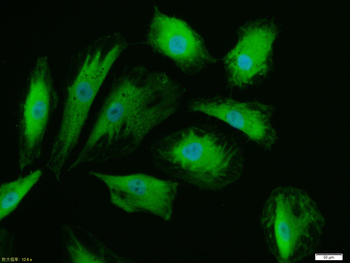
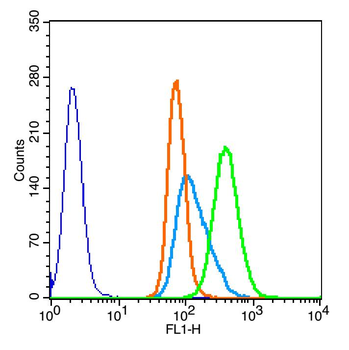
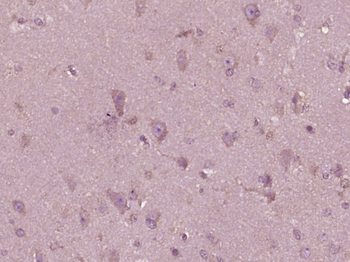
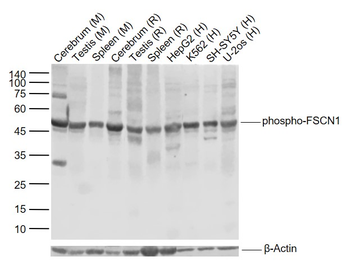
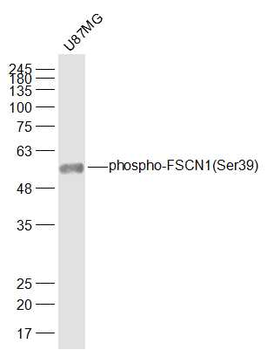
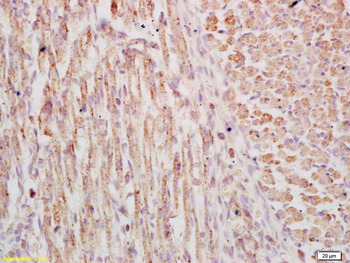
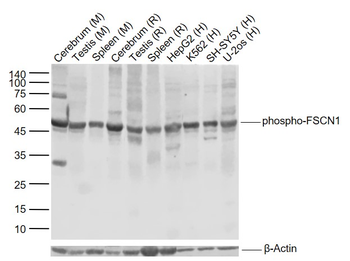
Item 1 of 6
| 已测应用 | WB |
|---|---|
| 稀释范围 | WB=1:500-2000 |
| 反应性 | Human, Mouse, Rat |
| 预测反应性 | Canine, Porcine |
关键属性
−| 抗体类型 | Primary Antibody |
|---|---|
| 宿主 | Rabbit |
| 克隆性 | Polyclonal |
| 同种型 | IgG |
| 免疫原 | KLH conjugated Synthesised phosphopeptide derived from human FSCN1 around the phosphorylation site of Ser39 AS(p-S)LK |
| 靶点 | FSCN1 |
| 分子量 | 51 kDa |
| 纯化 | Affinity purified by Protein A |
| 偶联 | Unconjugated |
储存与操作
−| 储存 | Maintain refrigerated at 2-8°C for up to 2 weeks. For long term storage store at -20°C in small aliquots to prevent freeze-thaw cycles. |
|---|---|
| 形态/外观 | Liquid |
| 缓冲液/防腐剂 | 0.01M TBS (pH7.4) with 1% rAlbumin, 0.02% Proclin300 and 50% Glycerol. |
| 浓度 | 1mg/ml |
| 有效期 | 12 months from date of receipt. |
| 免责声明 | For research use only |
别名
−FAN1; HSN; SNL; p55; fascin-1; Fascin; FSCN1_HUMAN; FSCN1; 55 kDa actin-bundling protein; Singed-like protein; FSCN1_MOUSE; FSCN1_RAT; fascin actin-bundling protein 1; singed (Drosophila)-like (sea urchin fascin homolog like); fascin homolog 1, actin-bundling protein (Strongylocentrotus purpuratus); Singed, drosophila, homolog-like; actin bundling protein; FSCN1 (phospho-S39); p-FSCN1; phospho-FSCN1; FSCN1 (phospho-Ser39)
相似产品
−- Item 1 of 1
Phospho-FSCN1 (Ser39) Rabbit Polyclonal Antibody [orb1183952]
WB
Canine, Porcine
Human, Mouse, Rat
Rabbit
Polyclonal
Unconjugated
100 μl, 50 μl, 200 μl 
Phospho-FSCN1 (Ser39) Rabbit Polyclonal Antibody (AP) [orb912447]
WB
Canine, Porcine
Human, Mouse, Rat
Rabbit
Polyclonal
AP
100 μlPhospho-FSCN1 (Ser39) Rabbit Polyclonal Antibody (Biotin) [orb501618]
WB
Canine, Porcine
Human, Mouse, Rat
Rabbit
Polyclonal
Biotin
100 μlPhospho-FSCN1 (Ser39) Rabbit Polyclonal Antibody (HRP) [orb503982]
WB
Canine, Porcine
Human, Mouse, Rat
Rabbit
Polyclonal
HRP
100 μlPhospho-FSCN1 (Ser39) Rabbit Polyclonal Antibody (AP) [orb1597356]
WB
Canine, Porcine
Human, Mouse, Rat
Rabbit
Polyclonal
AP
100 μl

质量保证
Explore bioreagents carefree to elevate your research. All our products are rigorously tested for performance. If a product does not perform as described on its datasheet, our scientific support team will provide expert troubleshooting, a prompt replacement, or a refund. For full details, please see our 条款与条件和选购指南.
常用数据库链接
基因符号
FSCN1
UniProt
UniProt 详情
−暂无 UniProt 数据
GV Kakurina, EE Sereda, MN Stakheeva, L Tashireva, OV Cheremisina, IV Kondakova The serum fascin-1 and tumor components containing this protein in patients with head and neck squamous cell carcinoma: A pilot study The Journal of Biomedical Research, (2025)